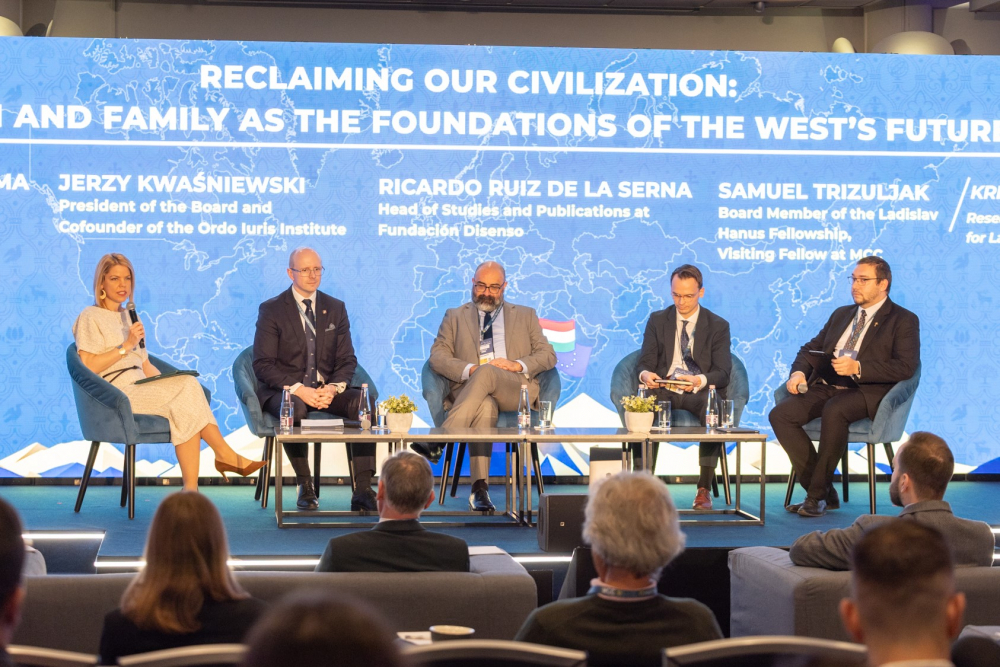
The MCC Budapest Summit on Reclaiming the West, held in Budapest from 10 to 12 March 2026, convened participants to examine the demographic, economic, cultural, and security challenges confronting Western civilisation. Central to the event was the question of whether the West can halt and reverse its present course of decline and reclaim a decisive role in shaping global civilisation. The conference sought not only to diagnose these challenges, but also to identify intellectual and strategic pathways capable of fostering the long-term renewal and sustainability of the Western world.
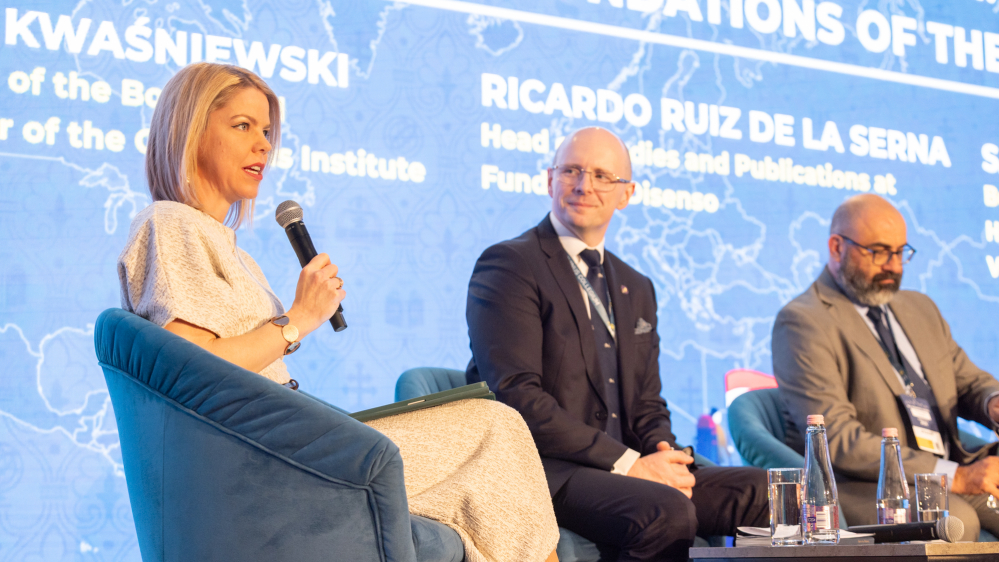
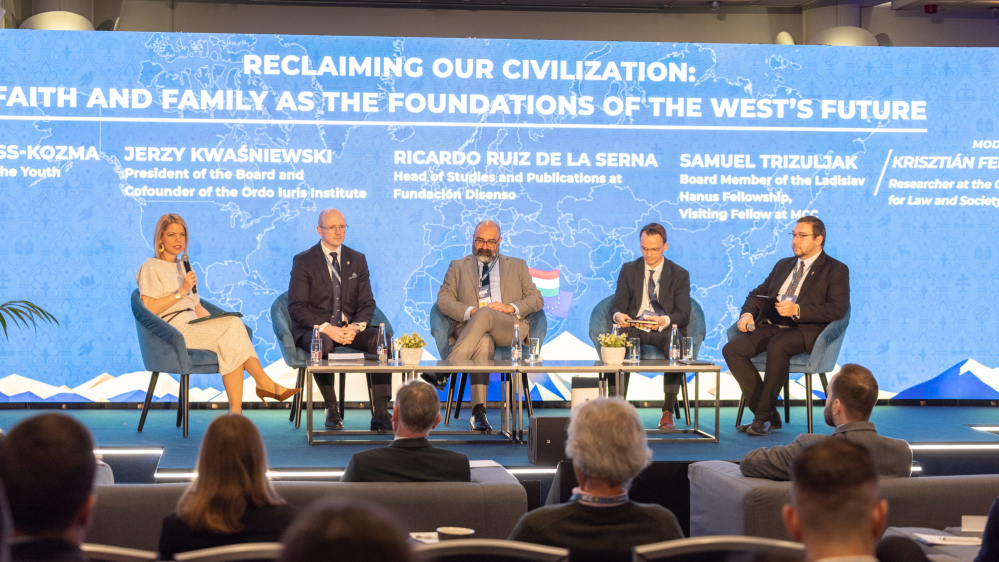
Kiss-Kozma Georgina, Deputy Director of the Youth Research Institute, participated in the panel entitled “Bastions of Civilisation: Faith and Family”, which centred on the proposition that the historical strength of Western civilisation has long been grounded in shared Christian cultural and moral foundations. The panellists contended that the decline of religious conviction, together with the weakening of the family as a social institution, poses significant challenges to Europe’s social stability.
Participants in the discussion—including Ricardo Ruiz de la Serna, Jerzy Kwaśniewski, Samuel Trizuljak, and Krisztián Fenyves—emphasised that Europe’s renewal is inconceivable without strengthening the social role of both faith and the family. In their view, the long-term viability of civilisation depends not only on economic and political responses, but also on a more profound intellectual and cultural renewal.
In her opening remarks, Kiss-Kozma Georgina highlighted that, although recent decades have witnessed profound social, economic, and cultural transformations, the most severe long-term crisis remains demographic in nature. Fertility rates across European countries typically remain below replacement level, leading to population decline and, concurrently, demographic ageing. She warned that, in a worst-case scenario, the demographic crisis could result in the collapse and eventual disappearance of entire cultures. As an illustrative example, she referred to South Korea, where fertility rates have fallen to such low levels that some demographers fear that, unless the trend is reversed, the country could effectively vanish—not as a result of war or pandemic, but as a consequence of one of the gravest outcomes of the crisis of modernity: childlessness. She further stressed that this challenge cannot be addressed solely through technological means; rather, the only viable solution lies in strengthening communities, including the family, Christian communities, and the nation.
According to Jerzy Kwaśniewski, President and co-founder of the Ordo Iuris Institute, faith constitutes a fundamental component of human life, without which social trust can readily collapse. He emphasised the existence of God, the Creator, who sacrificed Himself for humanity. Other participants in the panel included Ricardo Ruiz de la Serna, Head of Studies and Publications at Fundación Disenso, and Samuel Trizuljak, member of the board of the Ladislav Hanus Fellowship and visiting lecturer at MCC.