

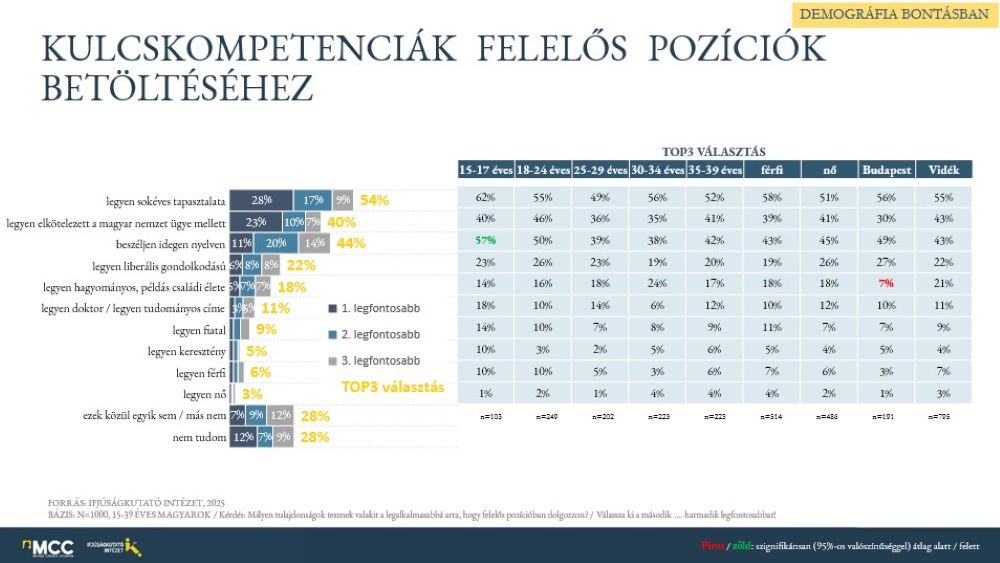
According to research conducted by the Youth Research Institute, extensive professional experience is currently the most important expectation young people hold of a good leader. The top three most important attributes also include commitment to national interests and values, and foreign language proficiency.
In its recent study, the Youth Research Institute at MCC sought to identify which characteristics Hungarian young people aged 15–39 consider most important in leaders occupying positions of responsibility, and what most strongly determines leadership suitability today. In this respect, extensive experience proved to be the most decisive factor. A majority of respondents (54%) included many years of experience among the three most important leadership attributes. The demand for substantial experience was particularly pronounced among the youngest respondents, those aged 15–17, 62% of whom ranked it among the top three criteria. By contrast, only 9% of respondents mentioned young age as one of the most important characteristics of a good leader. Overall, these findings appear to challenge the assumption that young leaders are inherently more popular among youth.
The second most important characteristic of a good leader was commitment to national interests and values, which 40% of respondents listed among the top three traits. Liberal thinking was included among the top-ranked attributes by only 22% of participants. Commitment to the nation was cited significantly more often by young people living in rural areas (43%) than by those residing in Budapest (30%).
The third most important attribute of a leader in a position of responsibility was proficiency in a foreign language. All other characteristics—such as gender or religious factors, outstanding educational attainment, or family background—ranked far behind these in importance.
The representative survey was conducted at the end of 2025. Data were collected through a self-administered online questionnaire (CAWI) from a sample of 1,000 Hungarian citizens aged 15–39.
Budapest, 10 February 2026