

It is frequently argued that individuals belonging to different political camps are becoming increasingly isolated from one another. Government supporters and opposition voters are said to encounter primarily the viewpoints of their own political side—thus living in so-called opinion bubbles. But is this really the case? A recent study conducted by Mathias Corvinus Collegium (MCC) significantly nuances this assumption. The majority of Hungarians appear to encounter political views that contradict their own convictions. Fewer than 5% of the population can be said to live in a political opinion bubble.
A joint research project conducted by the Center for Sociology and the Center for Political Science at MCC, focusing on political culture, sought to examine the extent of public interest in public affairs and politics, as well as the sources from which individuals obtain information on such matters. According to the survey, 64% of respondents report being interested in public and political issues. The primary sources of information on these topics are conversations based on personal relationships; however, individuals also frequently encounter political and public affairs content while consuming online media. Compared with 2023, the ranking of information sources has not changed significantly.
One of the principal objectives of the research was to assess the existence of opinion bubbles. A key indicator of democratic functioning is whether citizens have access to a plurality of viewpoints. As news consumption is increasingly shaped by social media, algorithms and individual preferences play a growing role in determining the information to which users are exposed. As a consequence, viewpoints that align with one’s own beliefs are more easily accessed, increasing the risk of becoming confined within an opinion bubble. To determine whether this is indeed the case, respondents were asked how frequently they encounter political positions that contradict their own convictions. The results may appear surprising: two-thirds of respondents (66%) regularly encounter political content that conflicts with their own views. The proportion of individuals who never encounter the political positions of the opposing side is less than 5%.
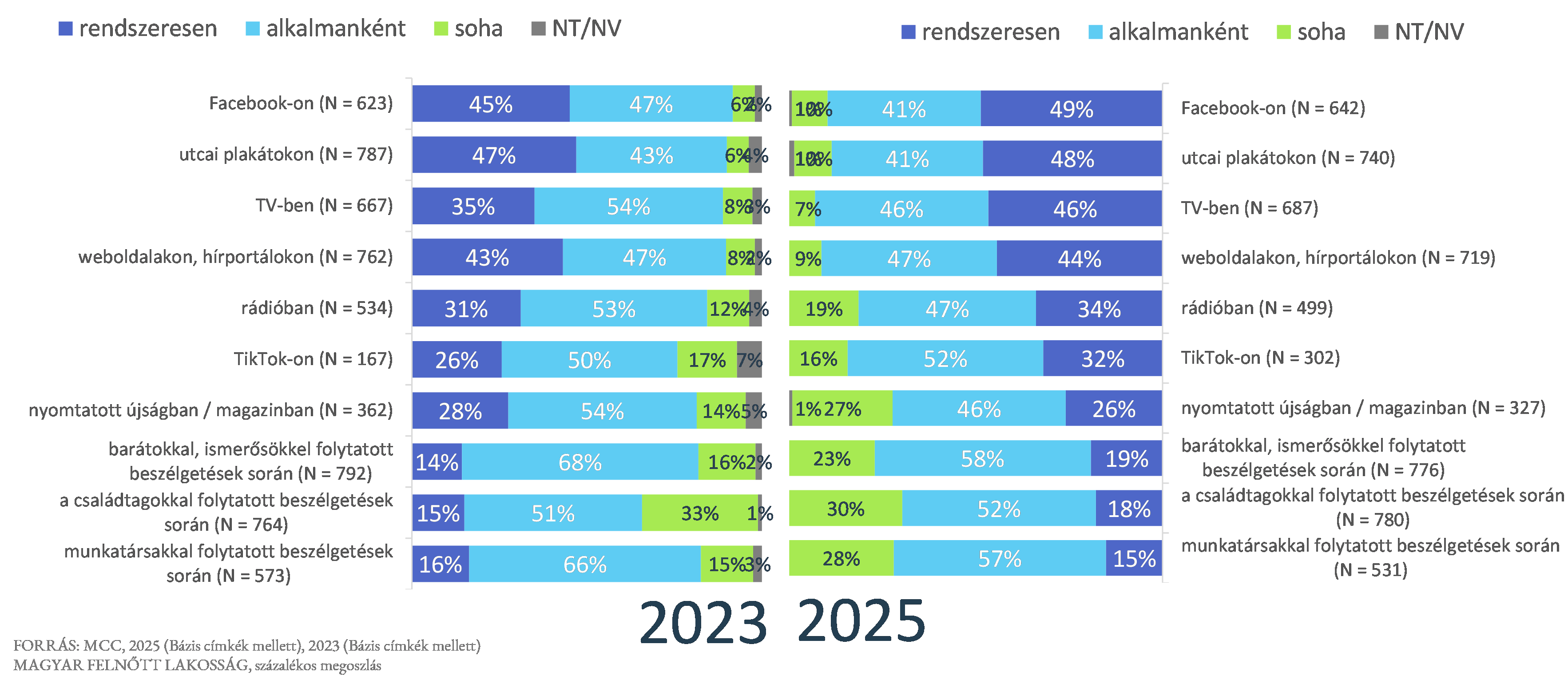
Exposure to differing viewpoints is most commonly facilitated by the internet, television, and billboard advertising, and least commonly by personal communication (with friends, family members, or colleagues). Highly educated, urban, young men are more likely to encounter a variety of political opinions than older women with lower levels of education living in smaller settlements. A natural relationship can be assumed between openness and curiosity towards opposing viewpoints and the likelihood of encountering differing opinions.
The MCC study examined the adult population of Hungary in September 2025. Data were collected through telephone interviews (CATI), with a total of 1,000 Hungarian respondents aged 18 and over surveyed using a representative sampling method.
Budapest, 3 February 2025